| Readme: | Short: Amiga emulator for MorphOS
Author: Yannick Buchy (papiosaur2 hotmail fr)
Type: misc/emu
Version: 0.9 (10.10.2026)
Architecture: ppc-morphos
Requires: MorphOS 3.20+, sdl2.library (gamepads), your own
Kickstart ROM (1.3 for the A500, 3.1 for the A1200)
URL: https://papio-software.com
OVERVIEW
========
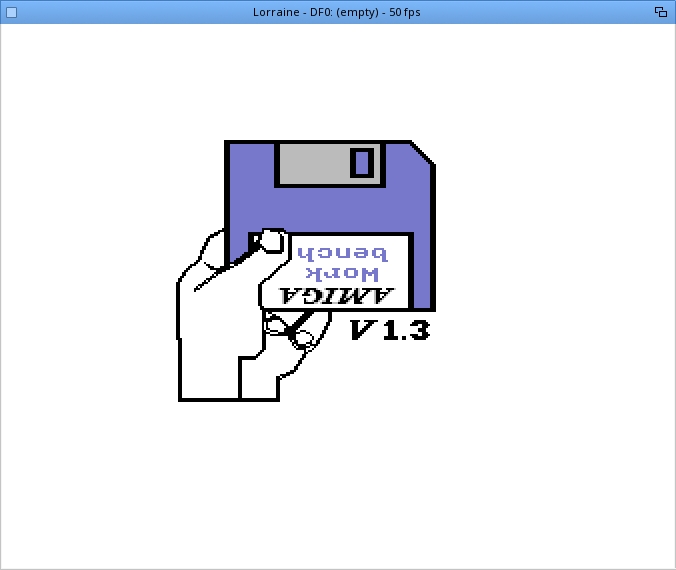
Lorraine is a new Amiga emulator, developed from scratch for MorphOS
and designed to run at full speed on PowerPC: 50 frames per second on a
PowerBook G4 and on a Mirari.
It emulates two PAL Amigas:
- Amiga 500: 68000 processor, OCS/ECS chipset (copper, blitter,
sprites, interlace), 512 KB or 1 MB of chip memory plus 512 KB of
slow memory;
- Amiga 1200: 68EC020 processor at 14 MHz with its instruction cache,
a 68030 with a 68882 FPU, or a 68040 or 68060 with its FPU, AGA
chipset (256 colours, HAM8, 32 and
64-bit fetch, wide sprites), 2 MB of chip memory and 8 to 32 MB of
Fast memory.
Both have Paula sound with the A500 filters, up to four floppy drives,
keyboard, mouse and joysticks.
It boots from floppy disk images, WHDLoad games straight from their
.lha archive, a hard disk file (HDF, A1200) or a MorphOS drawer seen as
an Amiga disk.
THE NAME
========
Before it became the Amiga 1000, the first Amiga was a prototype that
Amiga Corporation developed under the code name "Lorraine", after the
wife of the company's president, Dave Morse. It was shown at the
Consumer Electronics Show in January 1984, in a private corner of the
booth open only to invited guests: its custom chips were still a
table full of breadboards linked by a tangle of wires. The emulator
borrows that name as a tribute to the machine before the machine.
INSTALLATION
============
1. Unpack the archive anywhere.
2. Copy your Kickstart 1.3 ROM file into the Roms drawer (any name).
For the A1200, add a Kickstart 3.1 (A1200) ROM as well.
The ROMs are NOT included: they are still copyrighted.
3. Double-click Lorraine: the settings panel opens. Choose the model,
insert a disk in DF0: and click Start.
4. For WHDLoad games (optional), see WHDLOAD GAMES below.
USAGE
=====
Disk images: ADF, DMS and IPF (SPS/CAPS preservation images, with
their copy protections: Rob Northen Copylock, long tracks, weak
bits...), also inside ZIP, LhA and LZX archives. An archive holding
several disks put in DF0: spreads them over the drives: disk 1 in
DF0:, disk 2 in DF1:... up to DF3:, connecting the external drives it
needs. Put in another drive, it asks which disk to insert (or name it
archive.zip#2 for disk 2).
Automatic disk swap (ticked by default): when a program waits for
another disk in DF0:, Lorraine gives it the disk of DF1:, the one of
DF1: goes to DF2:... and the disk of DF0: to the last drive used. If
that is not the right one, the next disk comes a few seconds later.
It works with the programs that keep reading DF0: while they wait
(most games and demos), not with the Workbench "Please insert"
requester.
The DF0:...DF3: cycle in front of each drive swaps its disk with the
chosen drive by hand: for games that only read DF0:, choose DF1: in
the cycle of DF0: and disk 2 comes in DF0:, disk 1 goes to DF1:.
ADF disks are writable like real floppies: games and the Workbench
save to the ADF file (tick "Write-protect disks" in the panel to keep
them untouched). DMS and IPF images are read only.
Model: A500 or A1200. Lorraine reads the ROMs of the Roms drawer and
only offers those that suit the chosen model, with the chip and Fast
memory it can have (Fast: up to 8 MB on the A500, 128 MB on the A1200).
On the A1200, the processor (68EC020, 68030, 68040 or 68060) and the
FPU (none or 68882; built in on the 68040 and 68060) are chosen as
well: some 3D demos need the FPU. Applied at the next Reset.
The 68040 and 68060 run everything their FPU and integer unit leave
to 68040.library or 68060.library on a real Amiga: these libraries
are not needed. Their MMU does not translate addresses yet.
Floppy games start on the A500 they were made for, whatever the model
of the panel (an A500 ROM is needed in Roms). A game that uses the
A1200 (68020 instructions, AGA registers) restarts on an A1200 by
itself, and Lorraine remembers it; one that uses the FPU restarts on a
68030 with a 68882. A model chosen in the panel while a game runs is
kept for that game.
Hard disk: an HDF file on the IDE interface of the A1200. Host folder:
any MorphOS drawer seen as an Amiga disk, bootable, on both models.
Both apply at the next Reset.
WHDLoad games: see WHDLOAD GAMES below.
Drop an .adf file on the emulation window: it is inserted in DF0: and
the Amiga restarts on it. Drop it on a drive line of the Lorraine
panel to change the disk without restarting (disk 2 of a demo...).
THE PANEL: three buttons at the top choose what it shows.
Library: one list for the Disks drawer (floppy images and archives),
the WHDLoad drawer (.lha archives or unpacked drawers) and the
Harddisks drawer (HDF files, A1200 only, and drawers seen as bootable
partitions); the Type column tells them apart. Start selected entry
(or a double-click) starts it, the Amiga restarts if it was running.
The Filter field narrows the list as you type.
For each entry the list shows the Amiga it will start on: chipset
(OCS, ECS or AGA), CPU, Fast memory, CPU speed (Normal or Max) and
JIT, and where this comes from (Default, Auto when Lorraine found it
out, Manual when you chose it). Edit settings... (or a right click)
changes it for that entry; Default gives the choice back to Lorraine.
Under the list: the year, publisher and developer of the selected
game, from the Amiga Games List of Obligement, or the group and type
of a demo, from Pouet; and its screenshot (Alt+F12 in the game).
Custom config: your own Amiga, started with Start config: Machine
(model, ROM, processor, FPU, memory) and Hard disks (HDF file, host
folder). These apply at the next Reset. Entries of the Library set to
Default start with this Amiga too.
In game: what can change while the Amiga runs. Drives (the four
drives, fast loading, automatic disk swap, write protection), Display
& Sound (display area, monitor frame, panel attached to the Amiga
window or not, volume, drive sounds, stereo), Controllers and Speed
(maximum CPU speed, JIT). F12 opens it: to change a disk, F12, then
Insert in Drives, then click the Amiga window.
Settings > Library folders...: each drawer of the list can be another
folder (Choose...), Default goes back to the one next to Lorraine.
Settings are saved in Lorraine.prefs.
Press F12 to pause the Amiga and bring the panel to the front (the
MorphOS mouse pointer comes back); click the emulation window to go
back to the Amiga, which goes on. Closing the emulation window (or
Ctrl+Esc) stops the Amiga and shows the panel; Quit leaves Lorraine.
The emulation window opens in the middle of the screen, unless the
panel is attached to it (In game). The retro monitor frame shows
the Amiga's lights: POWER, DF0 to DF3 (a disk must be in the drive)
and HD.
CPU speed: on the A1200, Normal runs each processor at the speed of a
usual card (68030 at 50 MHz, 68040 at 40 MHz, 68060 at 50 MHz; the
68EC020 at the 14 MHz of the A1200), as far as your computer allows;
Max runs it as fast as your computer allows, like a faster card. The
JIT compiler (on by default) translates the Amiga program into
PowerPC code as it runs: the processor gets several times faster.
The title of the emulation window names what the Amiga started from:
the disk in DF0:, the hard disk or the WHDLoad game.
F12 pause and settings panel (releases the mouse), and
back to the emulation window
Ctrl+Esc close the emulation window, back to the panel
Alt+Return window / full screen (at the resolution of the
Workbench, the picture keeps its proportions)
F11 next display area (monitor, full overscan, auto
exact, auto stretched)
Alt+F11 retro monitor frame on / off
Alt+F12 screenshot of the game (JPEG, Amiga resolution) in
Data/Screenshots (made at the first one), one per
game: the next one replaces it; the Library page
shows it
Controllers chosen per port in the settings panel: mouse
(port 1), USB gamepad (automatic or by name),
numeric keypad (8 2 4 6, 0 = fire), keyboard
(cursor keys, Ctrl or right Alt = fire) or nothing.
Gamepads are read through SDL2: d-pad or left
stick to move, face and shoulder buttons fire. The
list follows the gamepads you plug or unplug.
"Buttons..." gives each button of the gamepad its own
job: fire, second fire, a direction (B = up to jump,
for instance) or an Amiga key. The ticks under the
ports show what each Amiga port receives, emulation
running or not.
Mouse captured by the Amiga while its window is active
Mouse speed in Controllers, 1 to 200 %: lower it for the games
that read the mouse themselves and find a modern
mouse too fast
From a Shell: Lorraine [disk] [rom] [CHIP=1024] [MODEL=A1200]
[FAST=8192] [DF1=disk] [DF2=disk] [DF3=disk]
[FASTLOAD=1]
A disk (or a WHDLoad game) given this way goes in
DF0: and the Amiga starts at once; a Kickstart ROM is
told apart by its size (256 KB, 512 KB or 1 MB).
WHDLOAD GAMES
=============
No Workbench is needed: Lorraine builds a small boot disk for each
game, the Kickstart ROM does the rest.
WHDLoad itself comes with Lorraine: WHDLoad_usr.lha, the official
archive from whdload.de, is in the Third-Party drawer, unchanged and
included with the kind permission of its author, Bert Jahn. Lorraine
takes the WHDLoad program out of it by itself. A newer WHDLoad_usr.lha
from whdload.de can replace it.
Needed once: a Kickstart 3.1 A1200 ROM (512 KB, 40.068 preferred) in
Roms.
Only for the games whose slave asks for a Kickstart image (such as
kick34005.A500): the ROM of that version in Roms. The .RTB files come
from skick346.lha, already in Third-Party. Lorraine tells you when
something is missing.
Why: many WHDLoad installs (mostly games that used AmigaDOS) run on a
Kickstart that WHDLoad loads into memory, not on the one of the
machine; the slave names the version it wants. WHDLoad needs that
ROM image and its .RTB file, a relocation table that lets it run
the ROM at another address (it holds no Commodore code). The .RTB
files come with SoftKicker, freely distributed on Aminet as
skick346.lha and included unchanged in Third-Party: Lorraine reads
the right .RTB from it and shows it to the Amiga next to the ROM,
without copying anything. Games without a Kickstart image need none
of this.
Put the game's archive (.lha, or .lzx) or its unpacked drawer (with
the .slave file) in the WHDLoad drawer, open the Games & Demos tab of
the Library page and double-click the game. You can also insert the
archive in DF0: or drop it on the emulation window.
The game stays in its archive: Lorraine reads it into memory (with
xadmaster.library, part of MorphOS) and shows it to the Amiga as a
disk. The last game started also stays unpacked in T:Lorraine-WHD, so
that starting it again is quicker. What the game writes (saves, high
scores) goes to WHDSaves/<game>, next to Lorraine; an unpacked drawer
keeps its saves inside, as with WHDLoad on an Amiga. Deleting the
archive removes the game; its saves stay in WHDSaves until you delete
them too. The options of the game icon (tooltypes) are used.
Lorraine switches to an A1200 with Kickstart 3.1 and at least 8 MB of
Fast memory; your previous
settings come back when a floppy disk is inserted in DF0: again.
The WHDLoad information window is skipped unless "Show the WHDLoad
window" is ticked in Settings > Library folders. To quit a game,
use its WHDLoad quit key (often F10), or close the emulation window.
Some games, mostly CD32 conversions, need libraries that are not in
the Kickstart ROM (lowlevel.library...): they are not supported yet.
CONTENTS
========
Lorraine the emulator
Lorraine.readme this file
History.txt what changed, release by release
Roms/ put your Kickstart ROM files here
Disks/ disk images (ADF, DMS, IPF, ZIP): a few free demos to start,
add your own; the Insert requester opens here
Harddisks/ HDF files and drawers used as hard disk partitions:
two 68060 AGA demos to start (see DEMOS)
Data/ the Amiga Games List and Pouet data of the Library
WHDLoad/ WHDLoad games (.lha or .lzx archives, or drawers)
Third-Party/ archives by other authors, each under its own
license: WHDLoad_usr.lha (WHDLoad 20.0, (C) Bert
Jahn, included with his permission) and
skick346.lha (SoftKicker 3.46, (C) Pavel Troller,
freely redistributable unchanged)
Papio-Software opens https://papio-software.com
Support opens PayPal to support the development
STATUS
======
Tested on real hardware (Mirari T1042, PowerBook G4): Kickstart 1.3
and 3.1, the demos Arte, State of the Art, Desert Dream (two drives),
Enigma, Mental Hangover, 9 Fingers, Dead Ahead and Starstruck.
The 68060 demos run slower than on a real 68060 card: they need a much
faster computer than a Mirari for a smooth picture.
Not yet available: hard disk on the A500, ADZ images, the MMU of the
68030/040/060, save states.
HISTORY
=======
See History.txt.
DEMOS
=====
The Disks and Harddisks drawers hold freely distributable productions
of the Amiga demoscene, included with respect and credited to their
authors. They will be removed on request.
State of the Art Spaceballs (1992)
9 Fingers Spaceballs (1993)
Desert Dream Kefrens (1993)
Enigma Phenomena (1991)
Hardwired Crionics & The Silents (1991)
Arte Sanity (1993)
Mental Hangover Scoopex (1990)
Dead Ahead Flex & Ephidrena (2025), AGA, 68060 (Harddisks)
Starstruck The Black Lotus (2006, final 2018), AGA, 68060,
64 MB of Fast memory (Harddisks)
TRADEMARKS
==========
Amiga is a trademark of its owner. Lorraine is not affiliated with,
nor endorsed by, Amiga Corporation, Cloanto or Commodore.
THANKS
======
- MorphOS Team for MorphOS
- Bert Jahn for WHDLoad and the permission to include it
- David "Daff" Brunet for the Amiga Games List (Obligement) and the
permission to use it
- Pouet (https://www.pouet.net) and its webmaster for the demo data and
the permission to use it
- CptBlood for the many tests and screenshots
- BeWorld for SDL2
- Skateman, MartinW, Patricks Retro Corner and one Anonymous for their support
|


 Ambient (151)
 Lorraine_0.9.lha