| Readme: | Short: First native Telegram client for Amiga
Uploader: michele.dipace@kaffeine.net (Michele Dipace)
Author: Michele Dipace <michele.dipace@kaffeine.net>
Type: comm/tcp
Version: 0.6
Replaces: comm/tcp/Amigram-MOS.lha
Architecture: ppc-morphos
Requires: MorphOS 3.x with its TCP/IP stack
WHAT IS THIS?
-------------
Amigram is the first native Telegram client for the Amiga, written
from scratch on Telegram's own MTProto protocol: no gateway, no proxy, no
web page. You sign in with your normal Telegram account. The
cryptography (RSA, Diffie-Hellman, AES, SHA and the SRP login for 2FA) is
built in, so it needs no MUI, no ixemul.library and no AmiSSL, only the
system's bsdsocket stack.
It uses the Telegram API and is part of the Telegram ecosystem, but it is
not made by Telegram.
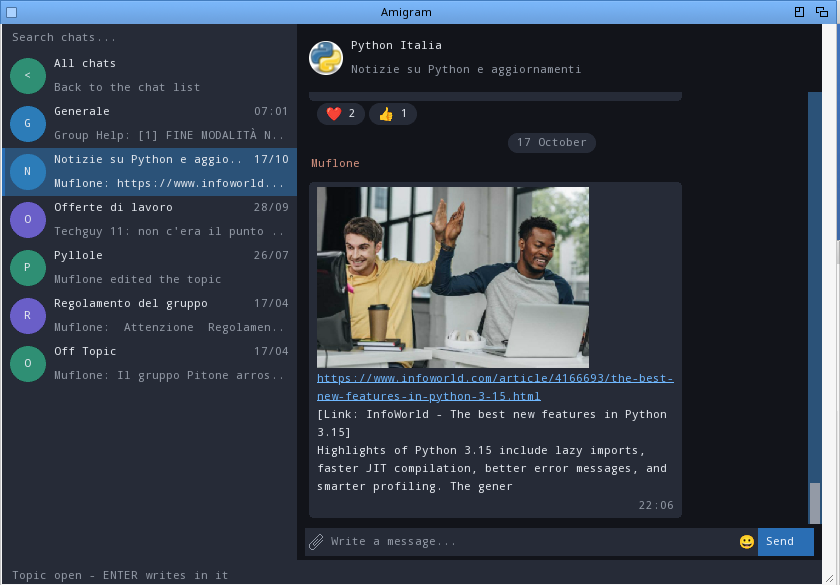
Amigram the window client (Intuition/GadTools): chat list with
avatars, bubbles, photos, emoji, menus. The same
program runs a text client from a Shell; the manual
gives the command.
WHAT CAN I DO WITH IT?
----------------------
Read and send messages in private chats, groups and channels. Reply,
react, forward, edit and delete your own messages, hide other people's
messages in groups. See read receipts and who is typing. Get a pop-up
and a sound for new messages, chosen per chat. Download and send files,
up to 250 MiB on this build. Photos, video frames and link
previews show in the chat, with a viewer for a larger copy; a text-only
mode keeps slow machines quick. Saved Messages works as a transfer
drawer between the Amiga and your phone or PC. The window remembers
where you left it and can open on its own screen.
GETTING STARTED
---------------
1. Copy this drawer to a writable volume.
2. Double-click Amigram.
3. Sign in: scan the QR code with Telegram on your phone (Settings >
Devices > Link Desktop Device), or press P for your phone number and
the code Telegram sends; then the cloud password if you use 2FA.
Next time it opens on your chats.
The login is kept in telegram-auth.bin next to the program. Never share
it: whoever has it is in your Telegram account. The archive has full
manuals in English and Italian, with notes for each platform.
WHAT IS NEW IN 0.6
------------------
ADDED
- Logging in with a QR code, the way Telegram Desktop does. The window starts
on a code; Telegram on a phone that is signed in scans it (Settings >
Devices > Link Desktop Device) and the login goes through by itself, with no
login code to wait for. Telegram had begun to hold those codes back from
this client for some accounts, on every system, so a new user could be left
unable to sign in. A cloud password is asked for afterwards, an account that
lives on another datacenter is followed there, and the code is renewed every
thirty seconds. P turns to the phone number and the code, as before. The
text client starts on the QR code too: a console of a 256-line Workbench
cannot hold one, so the code goes in a small window of its own on the
Workbench screen, which never takes the keyboard, and P with Return turns to
the number there; Ctrl+C there closes that window before the program ends.
The QR encoder is our own, written from the standard, and every code it
makes was read back by the Mac's own QR reader. On a screen whose pixels are
taller than wide (a PAL or NTSC hires screen without interlace, such as
640x256) the code is drawn with lower modules, from the display database's
own figures, so that it shows square on the monitor, and bigger than before;
graphics card screens, whose pixels are square, keep square modules.
- Log out, in the Amigram menu. After a requester it ends the session at
Telegram, removes what Amigram keeps of the account on this computer
(telegram-auth.bin and the other keys, the chat list and its archive, hidden
chats and messages, chat notification choices, avatars and cached photos;
downloads and settings stay) and quits; the next start shows the login. When
Telegram cannot be reached, or the window started offline, a second
requester offers to remove those files from this computer anyway; the
session then stays in Telegram's list of devices until it is ended from
another one. The text client has /logout: /logout yes logs out, /logout here
removes the files only.
- Future auth tokens, as Telegram's documentation describes them: when
Telegram hands one out, at a log out or a login, Amigram keeps it in
data/telegram-future-tokens.txt (twenty at most, never shown), and the next
request for a login code on the same computer presents them. A token
Telegram recognises lets the login go through at once, or straight to the
cloud password, with no code to wait for. In our tests Telegram gave none,
neither at a QR login nor at a log out minutes later, so the QR code stays
the way in when codes do not arrive.
- A text longer than one message goes as several messages, as the official
clients send it (issue #14). A 6 KB paste was cut to what one message holds;
the input line now holds four messages, 16 KB (8 KB on 68k), and ENTER sends
the text in parts, each cut at the last line break that fits or, failing
that, at the last space, with the reply on the first part. Paste says how
many messages the text will make. If a part does not go, the parts sent stay
in the chat and the rest stays in the input line with the reason. An edit
stays one message and says so when it grows longer; a long text left in a
chat keeps its first message as the draft. In the text client a line still
holds one message, 4096 characters.
- Play on a video, a voice message or an audio file (a user asked for one step
instead of downloading and opening by hand). Such a message has Play at the
top of its menu: the file is downloaded if it is not here yet and then
opened by itself, by the program chosen in the new "Media player..." line of
the settings (MPlayer, for instance, which plays voice messages too), or by
the Workbench when none is chosen. Once the file is here Play takes the
place of Open. The player gets the file's path as its argument and runs as a
process of its own, so the window goes on; a file that is in fact a program
is not run. Voice messages are Ogg Opus, which nothing in Amigram decodes
yet: the player does it.
- Pinned chats change their order by dragging, and Saved Messages can be
pinned. A pinned chat dragged among the others takes its new place at once
and the order goes to Telegram, so the other devices show it too; if
Telegram refuses, the old order comes back. A chat that is not pinned stays
below the pins, and the line the drag draws shows where the chat will go.
Pin and Unpin are now in the menu of Saved Messages as well; pinned there or
on another device, it moves up among the pins in its place.
- The Archive shows on the chat list: a thin line "Archived chats" at the top,
above the pins, while the Archive has chats, with how many of them have
something unread, in grey while they are all muted, as archived chats mostly
are. A click on it opens the Archive, as Amiga+A does. The number is
Telegram's own, read with the pinned chats; it is read again when a message
comes in an archived chat (at most every 20 seconds, every minute on 68k),
when a chat moves in or out of the Archive and when the Archive view is
left. The line is no chat: F1 to F10 still open the first ten chats.
- A draft keeps the message it answers. Text left in a chat while replying
goes to Telegram as a draft with its reply, and a draft that replies,
written here or on another device, comes back into the input line with the
reply over it, named after the message when the chat has it loaded, else as
a message further up. Saved Messages keeps a draft too, shown on its row
like any chat's: Telegram names that chat by the account's own user, which
the window now asks once at each start.
- Albums of files, of more than ten photos, and of icons dropped together.
Files picked together (or photos sent as files) leave as an album of files,
one grouped message as the official clients send it, instead of one message
each. Up to thirty can be picked at once, and more than ten leave as several
albums of ten, the caption on the first. Several icons dropped on the window
together are taken as files picked together: photos go through the photo
dialog as an album, anything else as an album of files. A video goes as a
file among them.
- Topics of forum groups made, renamed and closed. Chats > New topic... asks
for a name, makes the topic in the open group and opens it; the right button
on a topic's row offers Rename topic... and Close topic (Reopen topic when
it is closed). Telegram decides who may: what it refuses is said in the
status line. The text client has /topic new <name>, and /topic rename
<name>, /topic close and /topic reopen for the topic chosen. The service
lines now say "closed the topic" and "reopened the topic" instead of "edited
the topic".
- Drafts in forum topics. Text left in a topic stays as that topic's draft, on
Telegram too (it names the topic in top_msg_id, or Telegram files it as the
whole group's), and comes back when the topic opens again, also after
Amigram is started again; going to another topic of the same group keeps it,
as going to another chat does. The topic's row shows it after "Draft:", as a
chat's row does (not the topic open, whose draft is in the composer). In the
text client the "Draft:" line is the topic's chosen with /topic n, and
/topics marks the topics that hold one with [draft].
- Drafts in the text client. Text typed and left unsent when F1 to F10 change
chat is no longer thrown away: it is kept as that chat's draft, on Telegram
too. A chat with a draft, made here, in the window or on another device,
shows it as a "Draft:" line under its messages when it opens, and a message
sent there deletes it. The drafts are asked once when the first chat opens
(one request), and the updates keep them current.
- More than the most recent chats of a large Archive. Its view shows the 32
most recent (16 on 68k) and then ends with "More archived chats...": a click
lists the rest a part at a time (about 90 chats, 30 on 68k), and the same
row at the end of a part goes on with the next. A click on one opens it, and
it joins the Archive's view; ESC goes back to the Archive.
- A click left of a message's bubble selects it, as Select in its menu does:
the bar with Forward, Delete and Cancel comes up, and the next clicks choose
the others. For one's own messages, which stand on the right, that is all
the room beside them.
- Show in drawer selects the file's icon in the drawer it opens, on AmigaOS
3.5 and later and AmigaOS 4. The Workbench of MorphOS (Ambient) and of AROS
(Wanderer) answers no to that request, so there the drawer opens without a
selection, and without waiting for one. A downloaded file has no icon of its
own, so from 3.9 the drawer opens showing all its files. On a Workbench that
cannot open files for a program (3.0, 3.1), Open hands to MultiView what a
datatype can show, instead of only saying where the file is.
- Underlined words, as the phone sends them, show underlined here too, in the
text's own colour (a link's words stay in the link's colour). ++words++ in
the composer underline them, and an edit writes an underline back that way,
so it is no longer lost.
- An edit keeps the people its message names by name (someone without a
username, picked from the "@" list): the message is read once more when the
edit begins, and the names in the edited text go out as theirs again.
Before, the edit turned them into plain words.
CHANGED
- A chat no longer stays quiet for half a minute after it rang (a tester heard
the first and third message of a quick exchange, not the second). The pause
is a setting now, "Pause between sounds" in the settings panel: off by
default, so every message rings, or 5, 10 or 30 seconds, or a minute, kept
in data/telegram-notify.txt. The text client follows it too.
- The first menu is split in two (issue #20). It had grown to fifteen lines,
most of them about the chats, and those now have a menu of their own, Chats,
after Edit: Remove chat from list, Reload chat list and Archived chats, then
Send file..., Send photo..., Create poll... and Insert emoji... The Amigram
menu keeps Iconify, Settings..., About..., Help..., Support development...
and Quit. Every shortcut is the same as before.
- The line "Unofficial Telegram Amiga Client" after the name is gone. It was
there for the first releases after the rename, for whoever knew the old
name. The About window, the login screen, the text client, the readmes, the
manuals and the archive descriptions now carry the name alone. The
descriptions open with what the program is: the first native Telegram client
for the Amiga. The sentence that it uses the Telegram API and is part of the
Telegram ecosystem, but is not made by Telegram, stays.
- The pinned message's bar has a frame and reaches the window's right edge (a
tester reported that it read as one more message). It was the colour of an
incoming message, lined up with the messages, with the stripe a selected
message has. On a four-colour screen it was black on black; the frame shows
there too.
- ENTER sends while the emoji panel is open, as in the official clients. A
click on a glyph puts it in the text; after that ENTER inserted the same
glyph again and the message only went with Send (a tester reported it). Now
no cell is highlighted until an arrow key shows the highlight, and only then
does ENTER insert that glyph. After each insertion the next ENTER sends
again and closes the panel.
FIXED
- On AmiKit (AfA OS, with Directory Opus as the Workbench) the first download
into a drawer that had no icon yet froze the program, and icon.library with
it for every other program, until a reboot. The drawer's icon was written,
and then the notice to the Workbench that icon.library sends after it never
came back. The icon is now written without that notice (icon.library 44 and
later); the drawer shows its icon the next time its parent window is opened
or refreshed. Each step of a download is also named in the debug log.
- On MorphOS a first login opens on the chat list. It showed only the pinned
chats and Saved Messages until "Reload chat list": the list was not fetched
there at all since June, when fetching it froze the machine. That freeze was
cured two days later, and on a G5 with MorphOS 3.20 the list now comes at
once, as on the other systems.
- A login left half way no longer leaves telegram-auth.bin behind. The key a
login makes was saved there as soon as Telegram sent the code, so a closed
window or a Ctrl+C at the code prompt left a key nobody had signed in, and
the next start took it for a saved login and could not get in. The key now
waits in data/telegram-login.bin and becomes telegram-auth.bin only once
Telegram has signed it in, in the window and in the text client alike.
- A session that Telegram has closed for good is said so, instead of being
asked again every two seconds in silence. Telegram closes a session when the
same telegram-auth.bin is used in two places at once (AUTH_KEY_DUPLICATED),
or when it is ended from another device. The window had kept its chats on
screen, loaded nothing and answered an edit with "Not saved". Now no request
goes out with that key any more, and a requester explains what happened and
offers Log in again, which puts the old file aside as
telegram-auth-closed.bin and quits, so the next start shows the login. The
manuals now say to use telegram-auth.bin on one computer at a time.
- A message that mentions you and came in while its chat was open stayed an
unread mention on Telegram: the "@" button then offered it, on the other
devices too, although it had been read in front of you. Reading the history
does not read a mention. Such mentions are now read with the chat
(readMessageContents); the ones already there when the chat opened still
wait for the "@" button.
- A forum group found with "Search Telegram..." opened on General with the
chat list beside it instead of its topics, until its row was clicked again.
The search was still on when the group opened, and the sidebar keeps the
hits of a search. It now ends first, as a click on a result already did.
- A topic whose newest message is one's own could show it as unread. Telegram
counts one's own changes of a topic made from the list (closing it, opening
it again, renaming it) as news in it, and each one put a number on the row.
A topic whose newest message is one's own now counts nothing unread, as a
chat does after one writes in it.
- In the text client on the full screen, Tab back to the previous chat left
the prompt of the chat it left among the messages, as a line of its own. A
function key never did.
- The window could stop answering for good after a few hours, Ctrl-C included
(a tester reported it on AmigaOS 4). The notification chime waited for
ahi.device to give its request back, and on that machine the device once
kept one: everything stopped there until a reboot. The chime now goes
without waiting, comes back on its own, and is aborted after three seconds
if the device still holds it; a chime the device never returns no longer
holds anything up, and the next message beeps instead. On AmigaOS 3 the
chime also no longer waits for a free Paula channel, and on AROS a sound
file is stopped without waiting for the device either.
- A picture whose name does not end in .jpg or .png could not be sent as a
photo (a tester reported it). "Send photo..." did not list it, its icon
dropped on the window left as a file without asking, and when it was sent as
a photo all the same Telegram refused it: Telegram reads the ending of the
name a photo is uploaded under, and takes none, .iff or .txt for something
else. On an Amiga a picture needs no extension. The requester now lists
every file, what is picked or dropped is known by its content, and a photo
travels under a name that ends the way its content says.
- When Telegram refused an upload, the status line said "Upload failed" and
nothing else. It now says why.
- The MorphOS manual still said that the "@" list of a group's members was off
on MorphOS. It has opened there since 0.5.
- The MorphOS manual also said that the typing line of a group reads "someone
is typing". Since 0.5 it names who is typing there too, as on the other
systems: the members are fetched on MorphOS as well.
- "Is typing" hardly ever showed. Telegram tells who is typing only to an
account that is online, and this client never said it was: the line lit up
only while another device of the same account was online (seen on a G5 on
2026-11-15, where the typing came in the moment the phone was opened). The
account is now online while the window, or its photo viewer, is in front,
renewed every three minutes as Telegram wants, and offline when the window
goes behind, is iconified or closes, as with the official apps.
- The input line's recall with the arrow keys kept the first 255 characters of
a message sent, and ENTER sent them as if whole. It now recalls a message in
full.
- A chat pinned on Telegram was missing from the top of the list, pin and all,
when the list here did not have it (seen on a G5 on 2026-11-15: two pinned
groups did not show). The list is the one kept here, which on MorphOS starts
empty and grows by Search and Reload chat list, and the pins only marked
chats already in it. A pinned chat the list lacks now joins it whenever the
pins are read: at start, on Reload chat list and when they change on another
device. In a full list it takes the place of a hidden chat, or else of the
last one that is neither pinned nor open. A chat removed from the list here
stays out, pinned or not.
- After a chat was dragged to another place in the list, a message written in
the open chat could go to a different chat. The open chat was known by its
number in the list, and a drag from above it to below it (or the other way
round) renumbers it, while the transcript and the highlighted row still
showed the right one. The open chat is now found again by who it is after
every change of the list; if the list no longer has it, a message fails
rather than reach someone else.
- Once the chat list was full (128 chats, 64 on the 68k), a chat that became
active afterwards never appeared, not even with Reload chat list (seen on a
G5 on 2026-11-15: two busy groups were missing, neither hidden nor
archived). Reload chat list only ever added to the list. Telegram sends the
chats most recent first, and now, when the list is full, a chat it lacks
takes the place of one that Reload did not find among the more recent ones:
a hidden chat first, then the last chat in the list that is not pinned, open
or archived. The other chats keep their place and number, the Archive keeps
its share, and a chat removed from the list here stays out.
- A WEBP datatype installed from outside while Amigram was open (from Aminet,
with Easy2Install or its Install script) was not seen until Amigram was
started again. Amigram asked the system once whether it reads WEBP and kept
the answer, so turning "Sticker pictures" off and on offered Amigram's own
datatype again, whose Install then stopped at "A file is already there".
Turning the line on now asks the system again. The datatype installed from
the settings was already seen at once, and still is.
- A chat moved in or out of the Archive on another device while Amigram was
closed stayed where Amigram last knew it: hidden from the chat list, or
still in it, until the Archive was opened. When there is an Archive, Amigram
now reads it again from Telegram a few seconds after it starts (8 seconds,
20 on 68k, once, so the window does not open later) and puts the list right.
- An archived chat whose draft answers a message, or has bold or other
formatting in it (as Amigram and the phones save drafts now), could show in
the chat list instead of the Archive: the reader of the chat list skipped
such a draft only roughly and lost what Telegram sends after it, the chat's
folder among it. Both are now read exactly.
A COMMUNITY PROJECT
-------------------
Free software under the GNU GPL version 3 or later, and non-commercial.
Bug reports and wishes are welcome: testers on real hardware are what
moves this project forward.
Thanks to Enrico Vitale of ACube Systems for his tireless and fruitful
testing.
The icon is our own design. Carlo Spadoni optimised it for each system,
put it on a standard drawer for the drawer icon, and let me ship his
versions.
Source and issues:
https://github.com/kaffeine1/telegram-amiga
Development diary:
https://androidlab.it/en/telegram-amiga-mtproto-client-development-diary/
Support my work on Patreon, or with a one-time tip on Ko-fi
(voluntary: nothing is needed to use the program):
https://www.patreon.com/c/kaffeine1
https://ko-fi.com/kaffeine1
|


 Ambient (151)

 Amigram_0.6.lha